
Daily Supplement Stack
Building a Morning Vitamin D and Magnesium Routine
Marcus Chen · 14 January 2026
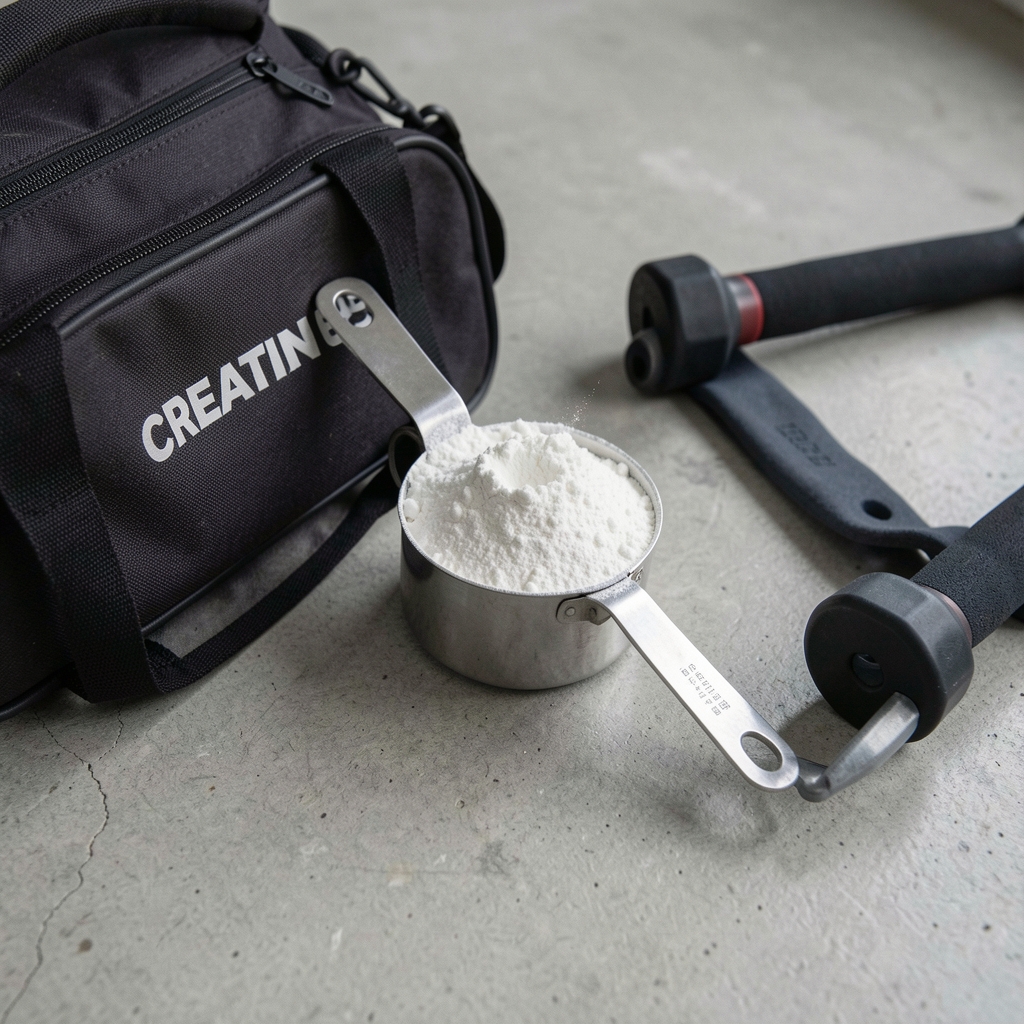
Creatine occupies an unusual position in the landscape of men's supplement habits. Unlike vitamins and minerals, which often address nutritional variety concerns rooted in dietary gaps, creatine is primarily understood in relation to physical output — specifically resistance training and short-duration, high-intensity activity. Its presence in published nutritional research is more substantial than most single-ingredient supplements, and the editorial case for covering it at Oravek Journal rests on that depth.
Creatine is a compound that occurs naturally in the body, formed primarily from the amino acids arginine, glycine, and methionine. It is also present in animal-source foods — red meat and fish are the most commonly cited — though the amounts available through diet alone are modest relative to the amounts typically used in supplementation research. The body stores creatine primarily in skeletal muscle, where it participates in the rapid regeneration of adenosine triphosphate (ATP) during short bursts of high-intensity effort.
This is the mechanism that has attracted so much published research interest: creatine's role in the ATP-phosphocreatine energy system is well-characterised, and it operates on a timescale that is relevant to the kind of effort men make in resistance training settings. A set of heavy deadlifts, a series of sprint intervals, a round of compound lifting — these activities draw heavily on the phosphocreatine system. Supplementing with creatine supports physical output over time in resistance training routines by increasing the available substrate for this energy pathway.
It is worth noting what creatine does not do, from an editorial perspective. It is not a stimulant; it does not produce the acute, session-by-session sensation of increased energy that some men associate with caffeine-containing supplements. Its effects on physical output accumulate over weeks of consistent use, through a process of muscle phosphocreatine saturation. Men who expect an immediate, obvious shift in their training output may find it a quietly understated addition to their routine.
Creatine monohydrate is among the most extensively studied single-ingredient supplements in the nutritional science literature. Published research spanning several decades has examined its effects across a range of exercise types, age groups, and dietary contexts. The editorial summary of that literature, as it relates to active men's nutritional habits, is relatively consistent: creatine supplementation supports physical output over time in resistance training routines, with the most clearly observed effects in short-duration, high-intensity effort patterns.
Independent nutritional research repeatedly observes that muscle phosphocreatine stores increase in response to sustained creatine supplementation, and that this increase correlates with improved performance on tasks that rely heavily on the phosphocreatine energy system. This is a carefully qualified statement. The research observes correlation and plausible mechanism; it does not support sweeping conclusions about transformation of physical capacity.
Research on creatine has also examined its interaction with protein intake and resistance training volume. A recurring finding is that creatine supplementation in the context of a structured resistance training programme produces more observable support for physical output than creatine supplementation in sedentary or low-activity contexts. This is a practical point for men who are considering adding creatine to an active lifestyle: the supplement appears to function as an addition to an already active pattern, not as a substitute for physical effort.
"The research observes a pattern. What a man does with that pattern — whether it finds a useful place within a broader nutritional and physical routine — remains a question of individual habit and context."
One of the more frequently discussed aspects of creatine supplementation is the question of loading — the practice of taking a higher daily amount for the first week or two in order to saturate muscle stores more rapidly, before settling into a lower maintenance intake. Published research has examined this approach in comparison with simply beginning with a consistent moderate daily amount and allowing saturation to occur over a longer period.
The observable difference, in terms of eventual muscle phosphocreatine stores, appears to be primarily one of timing: loading saturates stores faster, typically within five to seven days; the non-loading approach arrives at a similar saturation level over three to four weeks. For men approaching creatine as a long-term nutritional habit rather than a short-term performance intervention, the loading question becomes less significant. The editorial observation at Oravek Journal is that men whose supplement habits are built for consistency tend to prefer the non-loading approach for its simplicity.
The loading approach is also associated in some men with digestive discomfort, particularly at higher single-dose amounts. Published research suggests that dividing total daily intake into smaller amounts across the day mitigates this for most people. Again, the more practically oriented observation is that a supplement habit built around ease of maintenance is more likely to persist than one that requires careful scheduling and high single-dose intake.

For men who already maintain a vitamin and mineral supplement routine, creatine's addition is typically straightforward. It does not interact in a problematic way with the nutrients most commonly included in active men's daily stacks — vitamin D, magnesium, zinc, B vitamins — and it can generally be taken alongside food at any point during the day without loss of its nutritional effect.
The question of whether to take creatine before or after training has been examined in published nutritional research. The findings are not strongly directional: both approaches appear to support the same eventual muscle phosphocreatine saturation. Post-exercise timing has shown a modest signal in some published observations, but the editorial position at Oravek Journal is that timing consistency — taking it at the same point in a daily routine — matters more for habit sustainability than optimising the window relative to a training session.
Creatine monohydrate is the form most consistently observed in published research. Various branded forms — ethyl ester, HCl, buffered — have been marketed with claims of superior absorption or reduced side-effect profiles, but the published evidence base for these alternatives is considerably thinner than for monohydrate. For most active men building a daily supplement stack, creatine monohydrate represents the most straightforward choice in terms of consistency with what the research actually examines.
The editorial perspective that Oravek Journal brings to creatine is the same one it brings to any supplement: the question is not whether a compound has published research behind it, but whether that research is relevant to the pattern of daily life a reader is actually building. Creatine has an unusually robust published record for a single-ingredient supplement. That record is relevant to active men who maintain a consistent resistance training habit. It is less clearly relevant to men who are primarily focused on endurance, flexibility, or general movement rather than high-intensity resistance work.
Content published by Oravek Journal is selected based on published nutritional research and reviewed for editorial accuracy by a second editor before publication. The observation that creatine supports physical output over time in resistance training routines is supported by a substantial and consistent published record. The translation of that observation into an individual supplement decision remains, as always, a matter for the individual — ideally in consultation with a qualified nutrition professional who can contextualise it within a complete dietary picture.
What is perhaps most notable about creatine, from a purely editorial standpoint, is the absence of exaggeration in its published story. It does what published research observes it to do: contribute to the phosphocreatine energy system in a way that supports high-intensity physical output over time. That is a specific, useful, well-documented role. In a supplement landscape that frequently overpromises, it is, in the editorial view, a refreshingly contained one.
Articles published on Oravek Journal are editorial in nature and reflect the writers' observations on everyday supplementation habits and nutritional awareness for active men. The content is not intended as professional advice, nor as guidance for the management of any specific condition. Readers with specific concerns about their daily routines are encouraged to speak with a qualified wellness professional.